
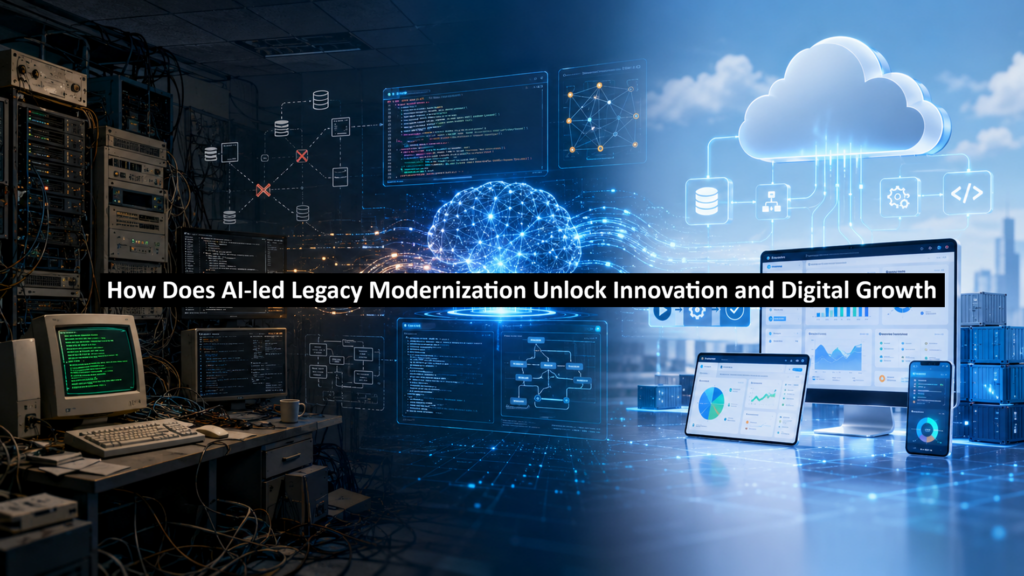
Summary : Legacy systems still run critical enterprise operations, but they also slow cloud adoption, automation, and AI readiness. This article explains how AI improves legacy modernization through faster system review, code refactoring, testing, data migration, and risk detection. It also highlights why human oversight remains essential for business logic, architecture, compliance, and long-term digital growth.
Introduction
In most large enterprises, the heavy lifting still falls on legacy systems. They run core banking, claims processing, inventory, billing, payroll, and decades of regulated workflows that the business simply cannot afford to break. McKinsey puts the scale of the problem starkly: as much as 70% of the software used by Fortune 500 companies was built 20 or more years ago. That aging foundation is now what’s holding the rest of the business back.
The cost shows up on the balance sheet. Deloitte’s 2026 Global Technology Leadership Study estimates that technical debt accounts for 21-40% of an organization’s IT spending. McKinsey, in a separate study, found that one large European bank was spending 70% of its IT capacity just to keep its legacy systems alive. Very little of that budget is left for cloud adoption, automation, or AI readiness.
Modernization is the practical way out. Enterprises have to improve the systems they still rely on, and they have to do it without disrupting the operations those systems support. The trouble is that traditional legacy software modernization has been slow, expensive, and risky. Programs stretch on for years, blow through budgets, and still carry the risk of breaking something critical on the way out.
AI is changing the math. It is making the modernization of legacy systems faster and more structured than it has ever been. What it doesn’t do, and this is the part most pitches gloss over, is remove the need for human judgment. The most reliable path forward is a hybrid one, where AI accelerates the work and experienced engineers validate the direction.
Read: Strategies For Prioritizing Information Effectively As A Student
The Old Way of Modernizing Legacy Systems
Legacy modernization was traditionally slow because teams had to decode old systems before changing them. Without complete documentation, sufficiently skilled resources, or clear visibility into migration, every step incurs costs, delays, and business risk.
Slow system review
Traditional modernization began with hand reviews of code, databases, dependencies, workflows, and whatever scraps of documentation still existed. A lot of legacy systems have not been documented for years, and the business logic survives only in tribal knowledge, much of it held by people who have already retired. Discovery alone could eat months before any real work began, which is one reason core modernization programs have historically demanded hundreds of engineers and multi-year timelines.
Heavy code refactoring
Developers had to read old code, infer the business rules, rewrite modules, and untangle dependencies by hand. The drag this creates is well documented. Stripe’s Developer Coefficient survey, which polled more than 1,000 developers and 1,000 C-level executives, found that the average developer spends 17.3 hours a week on maintenance, technical debt, and bad code. That’s roughly 42% of the work week. On legacy estates, the number runs higher.
Limited migration visibility
Teams often had to choose between rehosting, replatforming, refactoring, rebuilding, or replacing systems without a complete picture of what each system actually did or how it was used. Decisions got made on partial information. The result, predictably, was that critical applications often ended up on the wrong path.
Slow testing and validation
Most legacy environments were never designed for automation, so teams leaned on traditional tool-based testing. Without a reliable baseline of predicted behavior, which is something AI now enables, validation had to be done manually to confirm that modernized systems still behaved like the originals. QA bottlenecks were the norm, and every release slowed because of them.
Complex data migration
Legacy systems tend to store data in inconsistent formats across disconnected applications. Schemas drift over time. Definitions vary across business units. Reporting layers paper over the differences. All of this made migration, integration, and analytics readiness much harder than the project plan suggested.
High business risk
Legacy systems often sit underneath revenue-critical operations, which means even a small error during modernization can ripple into uptime, financial reporting, regulatory compliance, or the customer experience. They also hold sensitive customer, financial, and operational data, which turns any modernization gap into a security and compliance exposure. The numbers back this up. IBM’s 2024 Cost of a Data Breach Report puts the global average breach cost at USD 4.88 million, with financial sector breaches averaging USD 6.08 million. Older, harder-to-patch systems sit at the higher end of that distribution. That’s a big part of why so many transformation programs stalled before they really started.
How AI Improves Legacy Modernization
AI does not erase the complexity of legacy environments. What it does is take a lot of the friction out. Used well, AI-driven digital transformation compresses the time spent on discovery, refactoring, testing, and data preparation, which are the stages where traditional programs bleed the most months.
Faster system review
Large codebases that used to take quarters to even understand can now be scanned, mapped, summarized, and triaged in days. AI flags modernization candidates, identifies unused code, and lays out dependency graphs at speed. McKinsey reports that in a recent bank modernization, an orchestrated set of generative AI agents cut the relationship-mapping step from 30-40 hours down to about 5, and reduced an estimated 700 to 800-hour migration to roughly 40% less work overall. That kind of compression rewrites what is economically feasible in the early stage of a program.
Easier code refactoring
A lot of AI tools now offer code explanation, documentation, pattern detection, code conversion, and refactoring suggestions. McKinsey’s developer productivity research found that genAI-powered tools can cut the time spent documenting existing code by more than half and shrink legacy refactoring to about two-thirds of the original effort. Its own LegacyX platform, which uses agentic AI to coordinate squads of specialized agents, claims to accelerate modernization by 40-50% in early projects.
Better migration planning
Application usage, technical debt, performance hotspots, risk areas, and dependencies can now be analyzed in parallel rather than one after the other. That changes the rehost-versus-replatform-versus-refactor decision from a portfolio-wide guess into a per-application call. Deloitte frames this as a shift away from incremental application retirement toward AI-assisted modernization of the entire tech estate, with infrastructure and data transformation handled in coordination rather than in sequence.
Faster testing and validation
Test case generation, coverage gap detection, defect spotting, and regression support: all of it is now in scope for AI. The World Economic Forum’s 2026 review of enterprise AI deployments cites one financial services firm that automated up to 80% of legacy-to-cloud code migration with AI agents, cutting project timelines by as much as two years and reducing costs by 20-40%. Testing throughput is one of the main reasons those timelines compress so hard.
Cleaner data migration. Data mapping, cleansing, deduplication, schema matching, and anomaly detection are all areas where AI now contributes. Deloitte’s modeling suggests that data transformation alone can unlock a 52% increase in latent enterprise value over five years, which is a bigger lift than infrastructure modernization on its own. Preparing data with AI support makes the migration itself safer, and it improves downstream readiness for analytics, automation, and other AI use cases.
Lower business risk
AI-powered monitoring, impact analysis, and anomaly detection help teams catch risks earlier in the cycle, which supports safer releases, better rollback planning, and tighter execution. On the security side, IBM’s Cost of a Data Breach research found that organizations using AI and automation extensively in security operations saved an average of USD 2.2 million per breach compared with those that did not. The risk profile of modernization gets better at the same time as the productivity profile.
Is AI Alone Enough?
The productivity numbers are real. But they describe AI working inside a disciplined process, not AI working on its own. Several gaps still need human judgment.
Hidden business logic
Legacy systems carry business rules that were never written down anywhere. Tax handling, pricing exceptions, regional regulations, fraud thresholds, customer-specific carve-outs: these often live inside code branches that even the original team has forgotten existed. AI can explain what the code does. It may not understand why the logic is there in the first place. That distinction matters when the business depends on getting it right.
Unverified AI output
AI-generated recommendations can look correct and still fail in production. McKinsey’s own LegacyX team makes the point clearly: even when agents convert models with 90% accuracy, human developers remain in the loop. For systems handling payments, customer data, compliance, inventory, or core enterprise workflows, engineer review and structured validation are not optional.
Poor input quality
AI performs better when code, documentation, data models, and workflows are organized. A lot of legacy environments are the opposite. They are fragmented, undocumented, and inconsistent across business units. AI helps. It does not fix the underlying disorder on its own.
Complex architecture choices
Modernization involves decisions about cloud architecture, integration patterns, scalability, security, and governance. Those decisions carry long-term consequences for cost, performance, and flexibility, and they need experienced architects and engineers who understand the business as well as the code.
Compliance accountability
AI can support risk detection, audit logging, and documentation. Final compliance decisions still need a human on the hook. In banking, healthcare, insurance, and the public sector, regulators expect a person to sign off, not a model. The point is especially sharp in financial services, where Deloitte has noted that operating and maintaining legacy core systems is becoming more expensive precisely because the pool of experts who still understand them is shrinking.
The Hybrid Approach: AI Plus Human Oversight
AI accelerates legacy modernization, while human oversight ensures business logic, security, compliance, and production readiness stay under control.
AI takes on the repetitive, analysis-heavy, and documentation-heavy parts of the job. It helps teams assess systems faster, map dependencies, generate documentation, support refactoring, expand test coverage, and prepare data for migration. Human experts bring the parts AI cannot. Judgment. Business context. Engineering discipline. Risk control. They validate AI outputs, review architectural decisions, protect the workflows the business cannot afford to lose, and make sure compliance requirements do not slip through the cracks.
This hybrid model is what makes digital transformation with AI workable at an enterprise scale. AI improves speed and visibility. Human oversight makes sure that speed translates into accuracy, reliability, and alignment with the business. The combination also lays a stronger foundation for digital growth. Deloitte’s analysis shows that companies actively addressing technical debt through coordinated modernization can recover more than half of their trapped technology value over five years, a layer of value that typically shows up as faster product cycles, cleaner data pipelines, and a real ability to deploy AI on top of operational systems.
The pattern across most successful programs is the same. AI is treated as an accelerator inside a structured legacy application modernization program, not as a replacement for the engineering discipline. That is what lets enterprises modernize critical systems without trading speed for stability.
Conclusion
AI in legacy application modernization is helping automate system discovery, code refactoring, and risk assessment to a degree that was not possible even two years ago, and time-to-value has dropped because of it. The limitations of AI are still there, though. The strongest approach is hybrid. AI accelerates the work. Human experts validate the direction. Together, they help enterprises modernize faster, with stronger control and confidence. For cleaner data, cloud readiness, and AI-enabled workflows, AI-led legacy modernization is now the foundation for what comes next.