
Usually, generative AI is connected with chatbots, customer service, and systems that provide answers to questions on request. However, such tools represent just a small portion of what this technology can accomplish.
Generative AI is applied in business for routine operational processes, including document processing, data analysis, customization of content, and support of employees, as well as speeding up software development. In this case, the usefulness of the technology is not related to conducting a conversation but to eliminating repetitive tasks and enabling teams to utilize information wisely.
Processing and Summarizing Documents
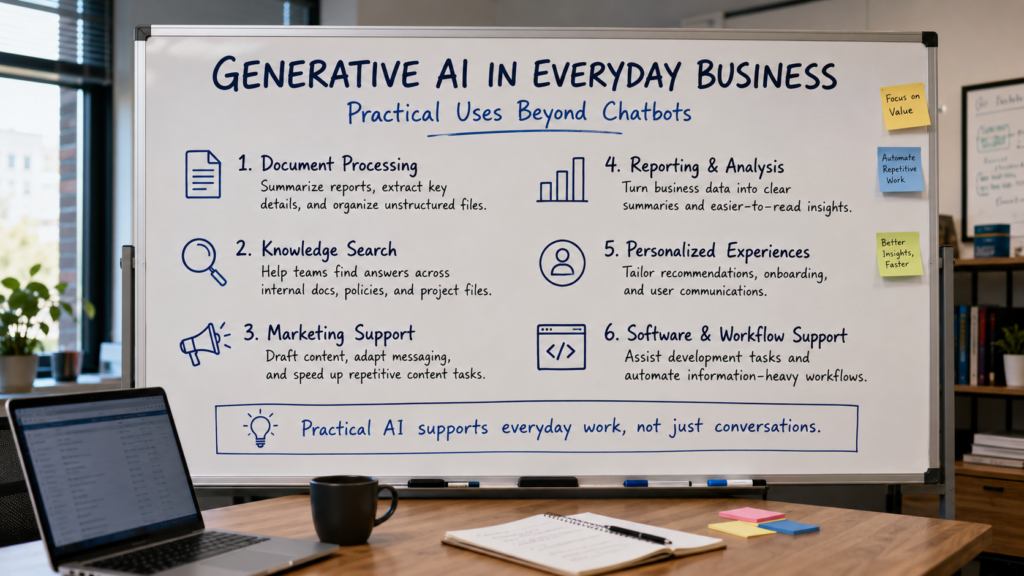
There are many businesses that devote considerable resources to processing contracts, receipts, reports, regulations, applications, and all other types of documents. Generative AI can help in extracting relevant information from files and transforming large quantities of unstructured data into a useful and easy-to-read document.
For instance, an organization is able to utilize AI for the summarization of lengthy reports, identification of significant terms in documents or classification of incoming files.
Read: Digital Health Innovations That Are Improving Patient Care
Internal Knowledge Search
Searching for information within a company can be surprisingly hard. Many important documents can be kept in a database, various portals, project files or other documentation.
Generative AI could help offer an easier way to access this information. Employees will not have to look through different systems but will be able to pose a question and get a response based on the data approved by a company.
Techniques like retrieval-augmented generation (RAG) can be a solution to this problem since this technique combines large language models with a pool of usable data.
Marketing and Content Operations
There is also a possibility that Generative AI will facilitate the repetitive stages of producing content. Marketing units may find it useful in the preparation of drafts, research summaries, product descriptions, modifications of old materials, or development of multiple versions of campaigns.
However, the main feature lies in not using AI for replacing human creativity but its application for carrying out the preparatory works and eliminating repeatable edits allowing professionals devote more time to strategic issues, positioning, and quality control.
Data Analysis and Reporting
For useful purposes, business data needs to be interpreted on the ground. Generative AI solutions can extract meaning of complex information by providing analytical solutions.
An example of how managers can take advantage of this technology is by using AI-powered systems that can get weekly summaries of results, clarifications about important data changes, or automatically convert raw operational information into a complete report.
With the use of artificial intelligence and systems providing analytical solutions, generative AI can be integrated into business intelligence solutions for a better interaction of employees with analytical data.
In any case, the generated data needs to be connected to relevant sources and verified before any important decisions are made based on it.
Customizing User Experience
The concept of personalization is much deeper than communication with a chatbot. Generative AI can enable companies to adapt their product offers, e-mail messages, onboarding materials, learning content, etc. to particular users.
Companies selling over the internet can create an introduction to a product based on customers’ traits. The tools for education can adapt the materials according to the achievements of a student. The application of finance can format complex information in a way that makes it easier for a particular customer to comprehend.
The idea is to make existing digital experience relevant without forcing people to come up with every possible option manually.
Support in Software Development
The development team is another important group that benefits from the utilization of generative AI technology. This technology can generate code, elucidate unknown elements, prepare documentation, recommend tests, detect problems, and hasten up redundant operations in engineering.
Companies interested in the development of generative AI solutions can integrate its functionality into the already used industrial system instead of using an AI tool individually.
Human inspection should be conducted because the code produced by AI may have errors, vulnerabilities or excessive complexity.
Workflow Automation
The most crucial change is the integration of generative AI with traditional automation.
Through this integration, the AI systems can do more than just produce text; they can analyze data coming in and dictate the next steps. An example can help illustrate that: the system receives a customer complaint, extracts the necessary information, categorizes it, responds to it and assigns the task to the appropriate employee.
Thus, generative AI becomes more than just a standalone tool; it becomes a part of the entire work process.
Final Thoughts
Although they are often less conspicuous than conversational AI, generative AI has various practical uses in business, including document processing, knowledge retrieval, reporting and analysis, personalization, software development, and workflow automation.
At this point, the question before enterprises has changed from “Where can we use chatbots?” to “Which repetitive and information-heavy tasks can AI automate?”
This mindset gives rise to more actionable applications of generative AI since it helps speed up and streamline existing workflows and processes rather than just being an additional feature due to the availability of technology. It also creates more opportunities for businesses to improve software delivery through AI-assisted development.